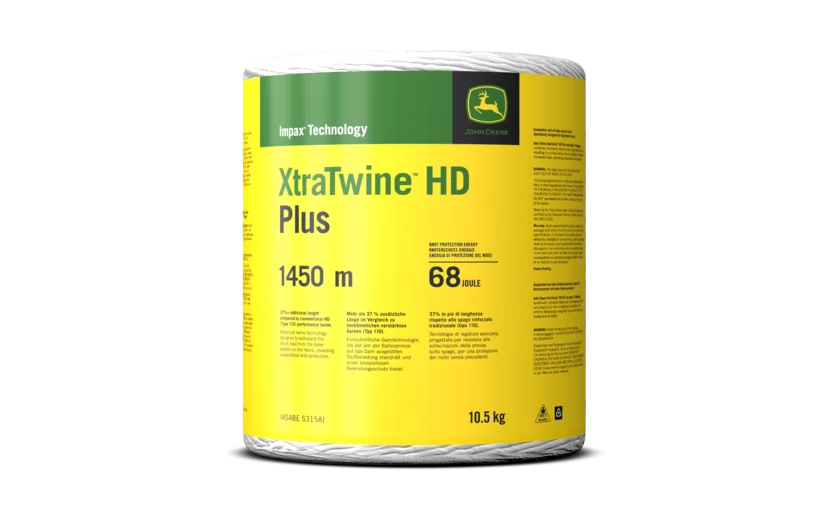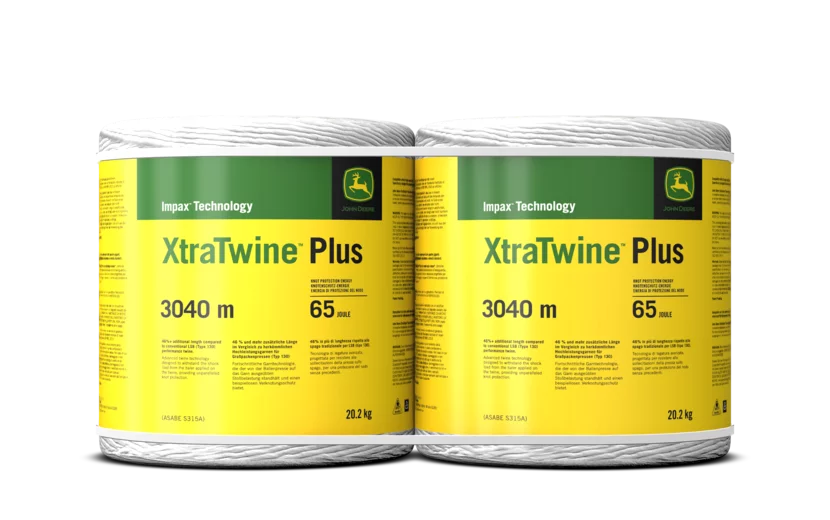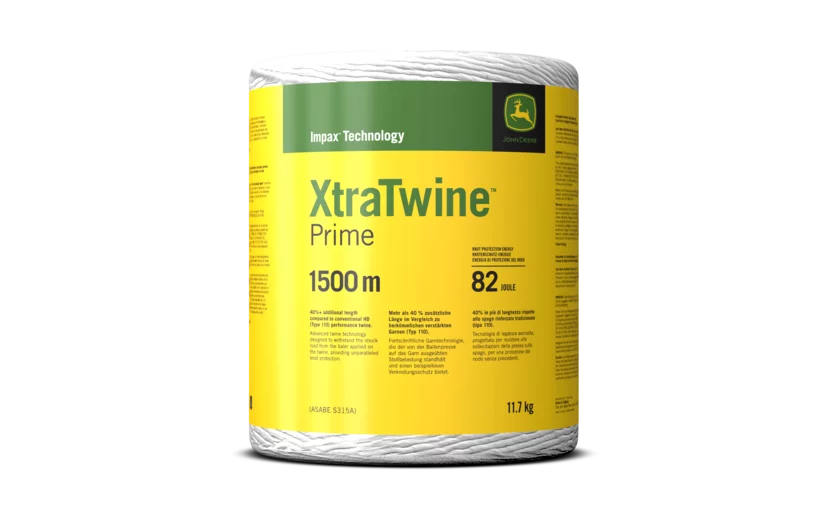

John Deere XtraTwine Rundballen


Ein komplettes Garnsortiment für Rundballenpressen – für kosteneffizientes Pressen dank optimierter Produktionstechniken.

Features & Benefits

Garantierte Spulenlänge

Spule enthält die angegebene Länge – keine „Plus-Minus“-Durchschnittswerte.

UV-Schutz

Hält das Garn auch unter extremer, dauerhafter Sonneneinstrahlung zuverlässig fest.

Umweltfreundlich

Spart bis zu 590 kg Kunststoff und 57 Folienverpackungen pro 10.000 Ballen.

Knotenfest

Bewährt und getestet für verlässliche und sichere Knoten bei jedem Ballen.

Specifications

Produktname Länge Gewicht Höhe Durchmesser Farbe Einheiten pro Palette Verkaufseinheit
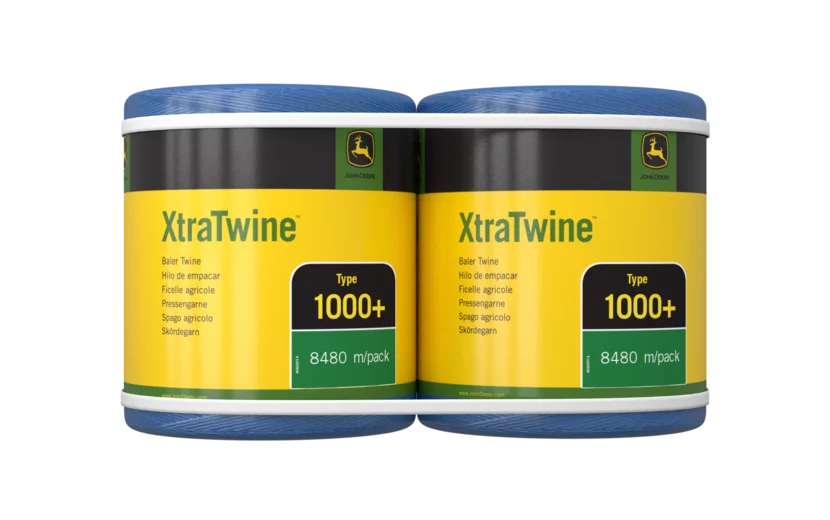
John Deere XtraTwine Rundballen
8,480 M
8 ± 3% KG
260 MM
225 MM
RECYCLED BLUE
96
Pack
Produktname
Länge
Gewicht
Höhe
Durchmesser
Farbe
Einheiten pro Palette
Verkaufseinheit
John Deere XtraTwine Rundballen
8,480 M
8 ± 3% KG
260 MM
225 MM
RECYCLED BLUE
96
Pack

1 Produkte


Finden Sie Ihren Fachmann

Wählen Sie Ihre Kategorie und Ihre Region aus.

Ergebnisse (0) Alle Experten anzeigen

Unsere zusätzlichen Services für Sie

Service Icon

Service

Know How Icon

Know How

Schulung Icon

Schulung

Feldexperten Icon

Feldexperten

Fragen über Bindegarn?

Alles was Sie wissen müssen.

Fragen über

Tipps zum Pressen von großen Quaderballen
Large Square Baling
Very careful attention should be paid to the bale pressure, depending on the type and condition of the crop being baled. During periods of extended dry and hot weather, for instance, straw bales may be noticeably lighter than during normal conditions, with the baler set to the same bale pressure setting.
In these circumstances, a decrease in pressure setting will overcome this; or, alternatively, a move to the next heavier twine is recommended.
For baling good quality large square silage bales, it is important to follow a few simple guidelines:

Ensure the crop has wilted to a minimum of 40 – 50% dry matter (DM), which will produce well-formed bales as well as excellent fermentation.
Ensure the twine box tension is reduced as much as possible, as twine friction experienced between silage bales during baling is much greater than between straw bales.
Eliminate as much air as possible from the crop when baling, as it is essential that sufficient crop is packed into the top of the bale to avoid misshapen bales being formed, which may be difficult for an automatic bale-wrapper to handle properly. A reduction in forward speed will help to achieve this by increasing the number of wads per bale.

Verwandte Themen