
CNH Netwrap

Length:
3,000 M

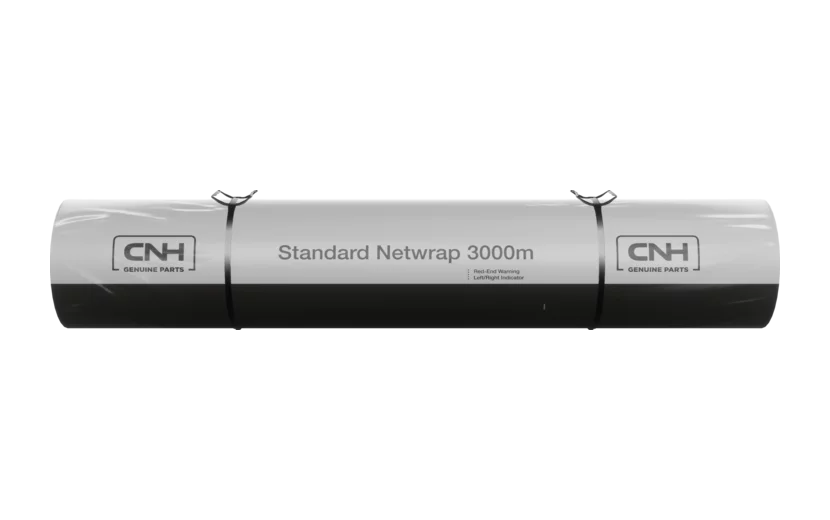
CNH netwrap is made for farmers and contractors who want excellent quality at an affordable price.
Cnh Netwrap 3000m F S

Features & Benefits

Right / Left marking

Right / Left marking

The cardboard core of each roll has a running direction marker which shows how to insert the roll correctly into the baler
Guaranteed Minimum Length

Guaranteed Minimum Length

Get what you pay for, each roll contains the length stated, not a plus-or-minus average
Roll Carry Handles

Roll Carry Handles

To make handling and transporting rolls easier
Roll end warning strip

Roll end warning strip

Know when it is time to prepare for a changeover. A red warning strip tells you when the end of the role is approaching
Durable

Durable

Excellent tear resistance and UV stable, this netwrap keeps silage, hay, and straw safe and secure until you need them
Versatile

Versatile

Optimized to run smoothly in all baler types

Spezifikationen

Produktname Length Width Diameter Rolls per Pallet
CNH Netwrap
3,000 M
1215 MM - 1230 MM
23.5 CM
32
Produktname
Length
Width
Diameter
Rolls per Pallet
CNH Netwrap
3,000 M
1215 MM - 1230 MM
23.5 CM
32

1 Produkte


Finden Sie Ihren Fachmann

Wählen Sie Ihre Kategorie und Ihre Region aus.

Ergebnisse (0) Alle Experten anzeigen

Unsere zusätzlichen Services für Sie

Service Icon

Service

Know How Icon

Know How

Schulung Icon

Schulung

Feldexperten Icon

Feldexperten

Fragen über Rundballennetz?

Alles was Sie wissen müssen.

Fragen über

Tipps zum Pressen mit Tama Netwrap+
When using Round Bale Netwrap, a few moments must be taken to ensure correct preparation of your machine in order to achieve the best results. The most common problems of net splitting, tearing, or fouling on feed rollers arise from the net ‘laddering’, where threads become broken, leading to a running stitch in the net running opposite to the direction of the net, eventually causing the net to separate where the ‘ladder’ has occurred. This can be caused by many different and varying circumstances but will always have the same ‘ladder’ effect.
Check that the area in which the roll sits is free from dirt and debris. Ensure that all metal surfaces the net comes into contact with are free from rust or sharp edges or weld spots (net box sides, spreader bars and rollers etc.), or dried paint ‘lumps’ on any surfaces which could damage the net. Clean up with emery paper if necessary. Also, check that the path for the net to the bale behind the feed mechanism is not dirty or rusty, which could restrict the net’s passage when feeding – often identified by a ‘lump’ of net at the start of the wrapping cycle. This is especially important when starting baling after winter storage.
Ensure the net is threaded correctly. Incorrect feeding of the net will cause incorrect tension being applied, leading to feeding and cutting difficulties which, in turn, will cause problems on subsequent net feed cycles. Where the net is fed through a series of fixed tension bars, always make sure these are clean and polished to avoid excessive friction. Excessive net friction or an uneven surface will cause the net to tear.
Where two rollers are used to feed the net, it is imperative these are correctly aligned and tensioned against one another, to enable the net to feed in evenly and under the correct tension. Incorrectly aligned rollers will produce a corresponding uneven net feed and subsequent cutting action at the end of the wrapping cycle. This will result in poor bale coverage and possible net fouling on the feed rollers at the start of the next cycle. The rollers’ surface should also be closely inspected for abrasions or damage, which could snag the net when feeding.
Ensure the feed rollers are clean of any moisture or residue. Never use an aggressive cleaning agent such as petrol or turpentine to clean rubber rollers.
Always dust rubber rollers down with French chalk or talc powder when loading a new roll of Netwrap, or use anti-static spray to reduce net static when operating. This avoids the net fouling and wrapping around the rollers when feeding in.
Carefully inspect the condition of the belt joiners on variable chamber balers for damage or worn connections, as this will snag the net and cause a tear, which will split the net on the bale.
Make sure the knife or cutting surface is clean and undamaged. Poor cutting action will result in an uneven ‘tail’ to the net, which can become tangled in the rollers and feed mechanism.
Warum Rundballennetz